A yard sign order goes wrong in small, specific ways. The board flexes in the wind because it was too thin for the size. The stake will not grip because the flutes run the wrong direction. The sign is legible from one approach and blank from the other because it was printed on a single side. None of these are design problems — the artwork can be beautiful and the sign still fails — and all of them are decided at the spec stage, before anything goes to print. This is a walkthrough of the five choices that actually determine whether a custom sign does its job: thickness, flute direction, size, sides, and how long it needs to survive outdoors.
Thickness: match the board to the size and the wind
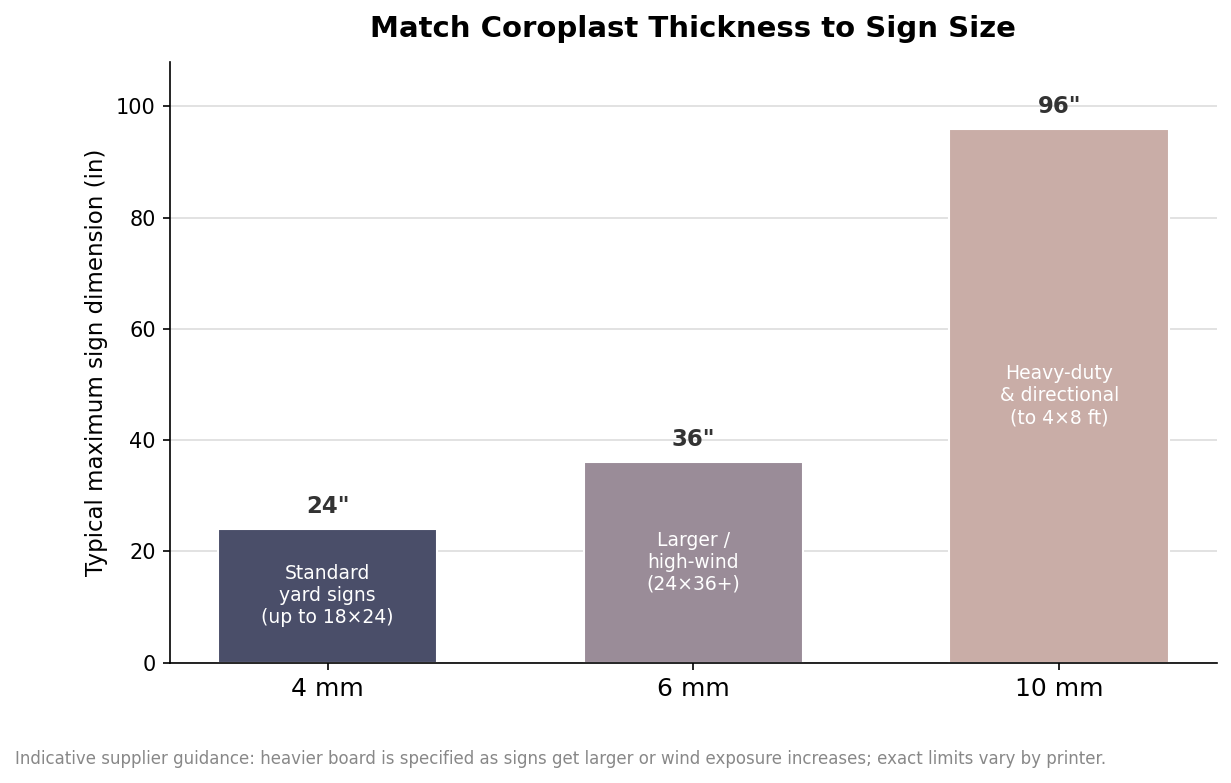
Corrugated plastic, often called by the brand name Coroplast, comes in a few standard thicknesses, and the right one scales with the sign’s size and exposure. The 4mm board is the workhorse of the political and real-estate market and is the correct choice for standard yard signs up to roughly 18 by 24 inches. Once a sign reaches 24 by 36 inches or will sit in a high-wind location, 6mm is the safer specification because the extra stiffness resists the flapping that fatigues and cracks thinner board. The 10mm board is a heavy-duty option for construction-site signage, large directional signs, and formats running up to 4 by 8 feet. Going thicker than the size requires wastes money; going thinner invites a bent sign after the first storm, so the honest rule is to let the finished dimensions and the location pick the caliper.
Flute direction: the detail that decides whether it stands up
Inside every sheet of corrugated plastic run parallel hollow channels called flutes, and their orientation is not cosmetic. For the common wire H-stake, the flutes need to run vertically relative to how the sign sits in the ground so the two legs of the stake slide down the inside channels and grip cleanly, holding the sign upright. On a standard landscape sign mounted with an H-stake, that means the flutes run parallel to the short edge. If you flip a sign to portrait orientation or order a custom shape, the flute direction has to be specified deliberately, because a sign whose channels run the wrong way simply will not accept the stake and has to be zip-tied or drilled instead. This is the single most common ordering mistake, and it costs nothing to get right if you tell the printer up front which way the sign will be staked.
Size: standard dimensions cost less and stake easier
Two sizes cover most of the market. The 18-by-24-inch landscape sign is the default for lawns, elections, open houses, and events, and it pairs with the widely stocked 10-by-15-inch or 10-by-30-inch H-stake. The 24-by-36-inch sign is the step up when a message needs to read from a moving car or a greater distance, and it is the point at which most printers recommend moving from 4mm to 6mm board. Custom sizes are always possible, but they carry two hidden costs: non-standard signs waste material on the press sheet, and they may not fit off-the-shelf stakes or frames, which pushes you toward more expensive hardware. Unless the application genuinely demands an unusual footprint, staying on a standard size keeps both the unit price and the installation simple.
Single-sided or double-sided: think about approach angles
The sides question is really a visibility question. A single-sided sign is fine when viewers only ever approach from one direction — a message facing a single lane of traffic, or a sign flat against a wall. Double-sided printing, where both faces carry the artwork, earns its modest added cost anywhere a sign sits perpendicular to two directions of travel: a corner lot, a median, a driveway entrance seen coming and going, or a directional sign guiding people down a road. Because corrugated plastic is opaque, a single-sided sign is genuinely blank from behind, so the practical test is simple: stand where every likely viewer will be and ask whether any of them are looking at the back. If yes, print both sides. Ordering double-sided as a default across a large run when half the placements are one-directional is a common way to overspend, so it is worth sorting placements before committing.
Lifespan: what “outdoor” actually means in months
Corrugated plastic is a temporary-to-medium-term material, not a permanent one. In real outdoor conditions it typically holds up for roughly six months to two years, and the spread within that range is driven mostly by sun and wind. Ultraviolet exposure is the main enemy of the print: unprotected colors begin to fade noticeably within about 12 to 15 months, and a south-facing sign that takes direct sun all day will fade faster than one facing north or east. Properly staked, coroplast tolerates wind in the 20-to-30 mph range before it starts to bend or tear, and moisture works its way into the flutes over time, causing warping and color bleeding especially at the stake holes. A UV-resistant laminate or coating is the most effective upgrade if the sign needs to last, commonly extending life by something like 30 to 50 percent — enough to move a one-to-two-year sign toward the two-to-three-year mark.
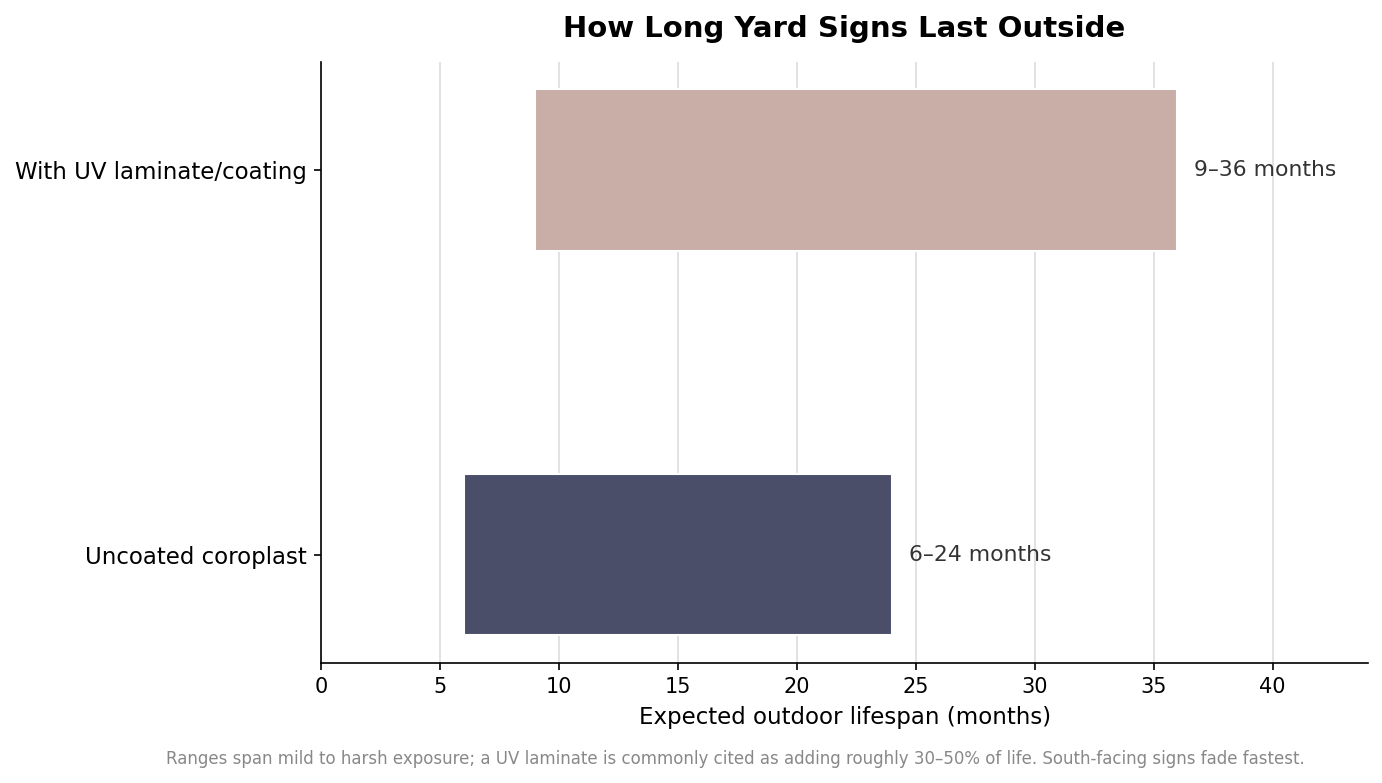
The planning point is to be honest about the job: a one-weekend event sign and a year-round directional sign are different specifications, and paying for lamination on a sign you will recycle in a month is as wasteful as skipping it on one you need to survive two summers. Decide the required lifespan first, and the coating, thickness, and even the color choices follow from it.