The wording on a yard sign gets all the attention, but the substrate underneath it decides how the sign performs. The same artwork printed on coated paperboard and on corrugated plastic will look identical on day one and tell two completely different stories by week six. Choosing a material is really a decision about how long the sign has to survive, what weather it will face, and how many times someone will pull it out of the ground and move it. Get that decision right and everything downstream, from stake choice to reorder budget, falls into place.
Corrugated plastic is the default for a reason
Corrugated plastic, sold under the trade name Coroplast and often just called coro, is the workhorse of the yard-sign world. It is a twin-wall polypropylene board: two flat printable skins bonded to a layer of internal flutes, like a plastic version of cardboard. That construction is what makes it rigid and dent resistant for its weight, and it is why a full-color 18-by-24 sign can weigh only a few ounces yet stand up to a summer of wind. Thickness is quoted in millimeters, and three grades cover almost everything. The 4mm board is the standard for political, real estate, and event signs up to about 18-by-24 inches. Stepping up to 6mm buys noticeably more stiffness for larger 24-by-36 formats and exposed, windy sites. The 10mm board is a heavy-duty grade meant for construction signage and pieces that get handled constantly, and it is available in panels as large as 4-by-8 feet.
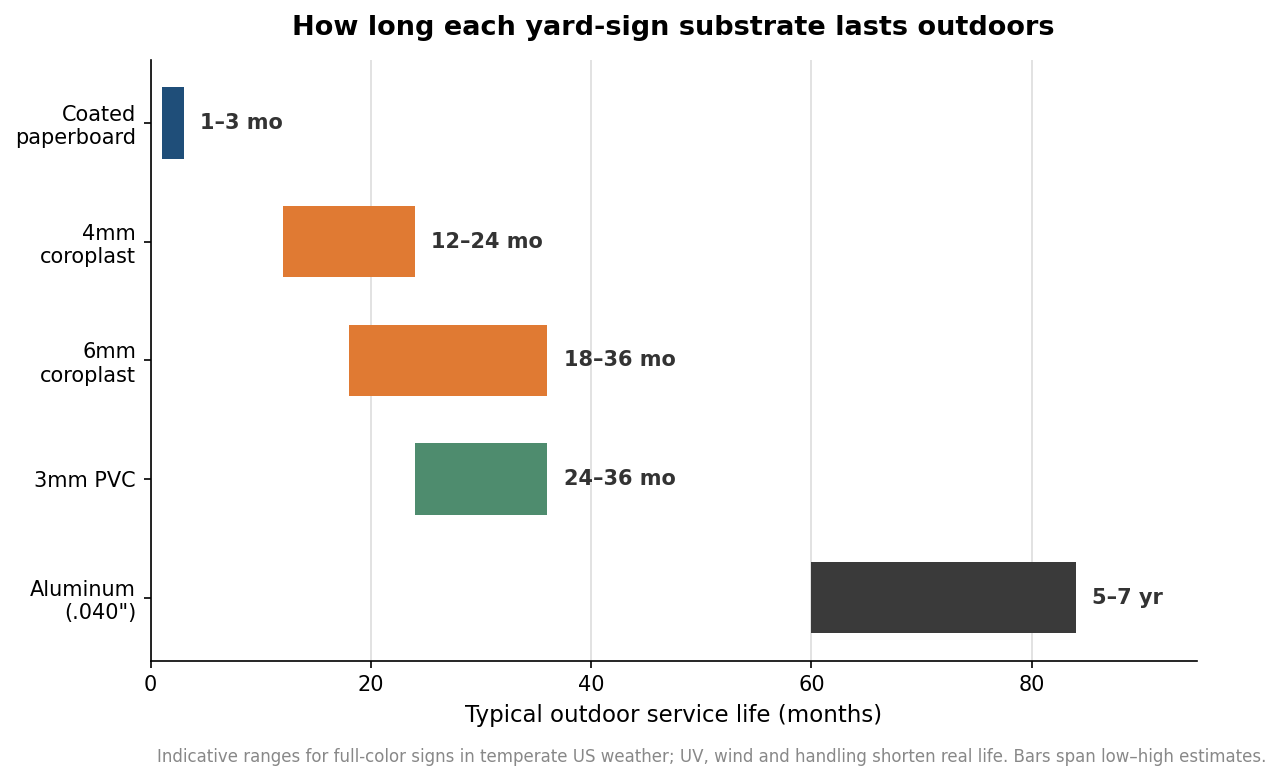
On price, coroplast is the economical default, and the per-unit cost drops steeply in bulk because coroplast carries no meaningful setup penalty for larger runs. Outdoors, plan on roughly twelve to twenty-four months of useful life before ultraviolet light makes the polypropylene brittle and the printed colors fade. That is plenty for a campaign cycle or a listing, and it is why most buyers treat coro as a consumable rather than a permanent fixture.
When to step off coroplast
Coroplast stops making sense the moment a sign needs to live for years rather than months. PVC board is the next step up: a rigid, smooth-faced sheet, commonly 3mm, that reproduces color crisply and holds up outdoors for roughly two to three years. It costs noticeably more per panel than coroplast, and it suits semi-permanent business and directional signs where the coro look reads as too temporary. Aluminum is the long-haul option. A 0.040-inch aluminum panel is rust-proof and fade-resistant, lasts five years or more, and can be refreshed with a new vinyl overlay instead of being thrown away, but it sits at the top of the cost range and is overkill for anything short-term. At the opposite end, coated paperboard is the cheapest substrate, and it is genuinely fine indoors or under cover, but it surrenders to moisture in as little as one to three months outdoors. The service-life chart above shows the tradeoff: the longer a substrate lasts outdoors, the more it costs per sign, so tell us how long the sign has to live and we will quote the cheapest material that gets it there.
The two specs people get wrong
Two details cause more reprints than any others, and both are easy to fix at the order stage. The first is flute direction. The internal channels in a coroplast sheet run one way, and standard H-wire stakes slide into those channels from the bottom edge. For a normal landscape sign the flutes should run horizontally, parallel to the long edge, so the stake legs seat cleanly. Order a portrait sign, or a top-mounted one, and you need the flutes running vertically instead. Get this backward and the sign simply will not mount to a standard stake, which is a frustrating discovery to make with a thousand pieces on a pallet. A good printer asks about orientation; if yours does not, state it explicitly.
The second is print method, which quietly drives both cost and appearance. Screen printing lays down thick, durable ink and is economical when you are running hundreds or thousands of the same one- or two-color design, but each color needs its own screen, so it gets expensive fast for full-color art. Digital and UV-flatbed printing goes straight onto the board with no screens, which makes it the right choice for short runs, photographs, gradients, and jobs where every sign is different. For a fifty-piece real estate order with a logo and a headshot, digital wins; for five thousand identical two-color campaign signs, screen printing usually costs less per piece.
Match the material to how long the sign must live
The cleanest way to specify a yard sign is to work backward from its expected life. If the message expires on a known date, an election, an open house, a weekend sale, then 4mm coroplast is almost always the correct answer, and any money spent on a tougher substrate is wasted. If the sign marks something semi-permanent, a business that will keep the same address and branding for a couple of years, PVC earns its premium by not looking weathered halfway through. Reserve aluminum for the genuinely permanent: parking, wayfinding, and regulatory signs that you do not want to think about again for half a decade. And keep paperboard indoors, where its low cost is an advantage and its weakness never gets tested.
One last practical note on quantity and timing. Because coroplast has no real economy-of-scale penalty at the printer, ordering a modest buffer over your headcount rarely adds much cost and saves a rush reorder when signs get damaged or walk off. Where a figure here is given as a range, treat it as indicative: real-world lifespan depends heavily on sun exposure, wind, and how often the sign is handled, and a coro sign baking on a south-facing corner all summer will age faster than the same sign in dappled shade. Specify the substrate for the job, get the flute direction and print method right, and the sign will do exactly what the wording asks of it.